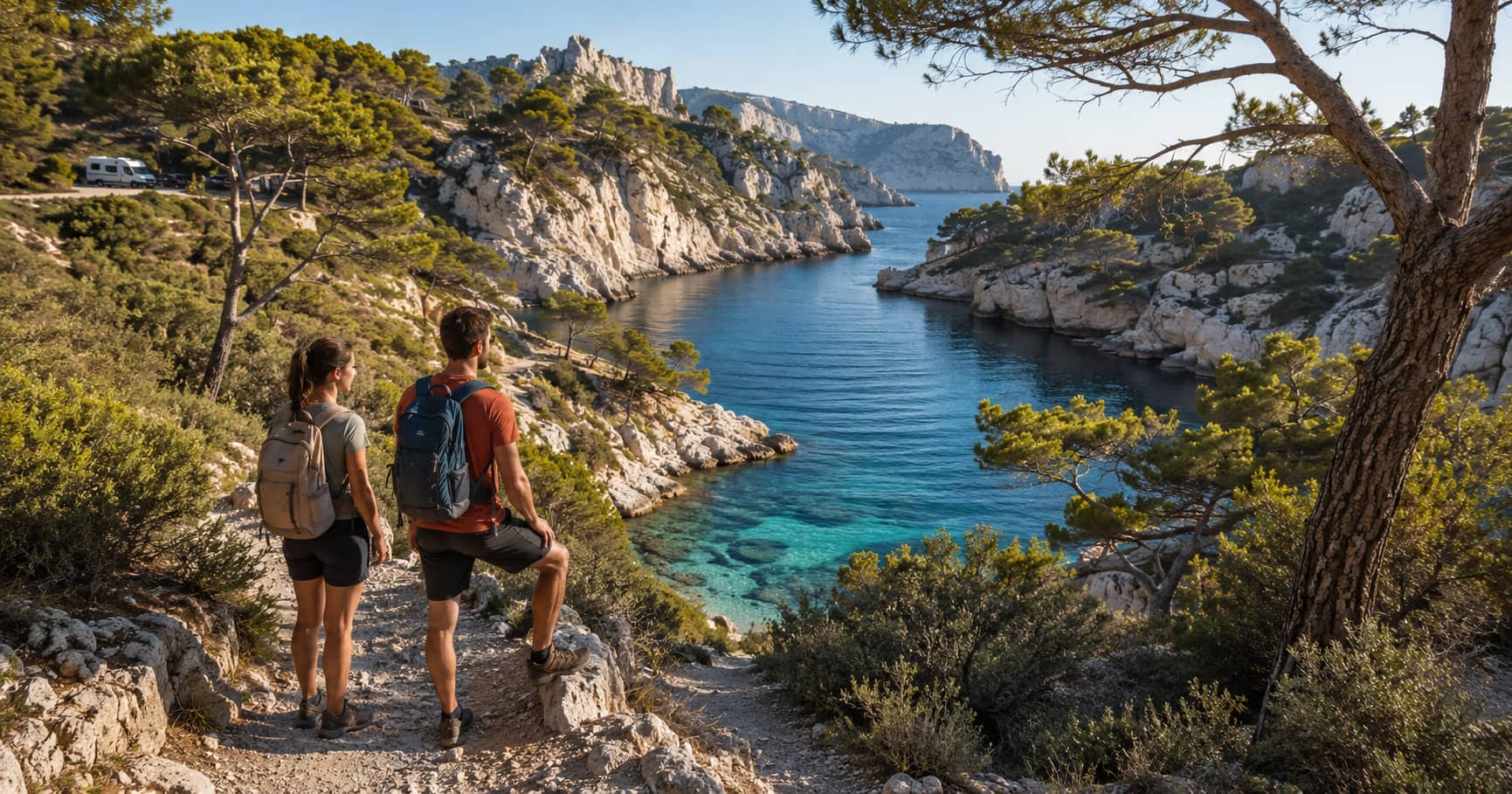
The Calanques look close to Aix-en-Provence on a map, but a successful day trip depends on access rules, fire risk, transport and heat rather than distance alone. In summer, roads can close, parking fills early and entry to forest areas may be restricted. A rigid plan built around one car park can fail before the walk begins.
Use this guide as a decision process. Choose the type of Calanques experience first, check the official status the evening before and again in the morning, then decide whether to approach from Marseille, Cassis or by boat. The goal is not to collect the greatest number of viewpoints. It is to complete one realistic outing without creating a parking, safety or timing problem.
Choose between a hike, a coastal visit and a boat trip
A walking day requires suitable footwear, water and confidence on rocky terrain. A coastal visit may focus on a village, harbour or accessible shoreline with a shorter walk. A boat trip can provide views when land access is restricted, although weather and operators still determine whether it runs. These are different activities, so do not treat one as an automatic replacement for another without checking what your group can manage.
Families, older travellers and anyone affected by heat should favour a shorter objective with an easy retreat. Experienced hikers can choose a longer route, but summer is not the time to improvise. The official National Park guidance recommends planning the route, checking weather, staying on marked paths and carrying at least 1.5 litres of water per person for each half-day.
Check fire-risk access every day from June to September
The Bouches-du-Rhône authorities assess forest-fire risk daily in summer, and access to massifs can be limited or prohibited. The Calanques National Park states that from 1 June to 30 September land access may be closed to protect visitors and nature. A forecast saved two days earlier is not enough; decisions can change with wind, temperature and vegetation conditions.
If access is closed, do not try another unmarked entrance or follow people around a barrier. Choose an authorised alternative, such as a city day, a museum visit or a boat outing that complies with current rules. The closure is an emergency-management measure, not a suggestion. It also affects whether rescue services can safely reach people who ignore restrictions.
Sugiton requires extra planning in peak periods
Sugiton and the Pierres Tombées area use a free reservation system on selected busy dates to reduce erosion and overcrowding. For 2026, the National Park lists reservations on 20 and 21 June, daily from 27 June to 30 August, and selected September weekends. Dates can change in later years, so verify the current calendar rather than copying an old itinerary.
A reservation does not remove the need to check fire risk or weather. It controls visitor numbers, not all other conditions. Save the confirmation offline, arrive with enough time for the approach and keep an alternative plan. Never build an expensive day around a non-refundable private transfer unless its cancellation conditions account for official closures.
Avoid taking a campervan to the final trailhead
Roads to Sormiou, Morgiou and Callelongue can close to motor traffic at busy times, and roadside parking is tightly controlled. The National Park warns that illegal roadside parking can obstruct buses and emergency access. Large vehicles add turning and clearance problems even where private cars can pass.
Leave the campervan at the campsite or a confirmed legal parking location and use public transport, a booked transfer or a smaller vehicle where appropriate. This is one reason Aix works well as a base: you can keep the overnight setup intact and make the coastal trip with only what you need. For a broader summer routine, review the site’s Provence heat advice.
Build the day around morning conditions
Leave early enough to walk before the strongest heat, but do not confuse early departure with guaranteed parking. Prepare breakfast and water the night before, use a soft bag rather than carrying unnecessary campsite equipment and set a turnaround time. Swimming can be refreshing, yet the return climb may be hotter and harder than the descent.
Wear shoes that grip polished limestone, protect your head and carry food that tolerates heat. Mobile reception can vary, so download the route. If mistral or strong coastal wind is forecast, reassess exposed paths and boat plans. The sea may look calm from inland while conditions along cliffs are uncomfortable.
A flexible plan is the safest plan
The practical sequence is simple: confirm access, confirm any reservation, select transport, check weather and define a shorter fallback. Do not let the wish to see one famous cove override official information. The Calanques are a protected national park with limited space, fragile soil and serious summer fire exposure.
Use the official Calanques visit planner for current access and regulations. A good day from Aix is measured by a safe return and a manageable schedule, not by how far you pushed into the park.