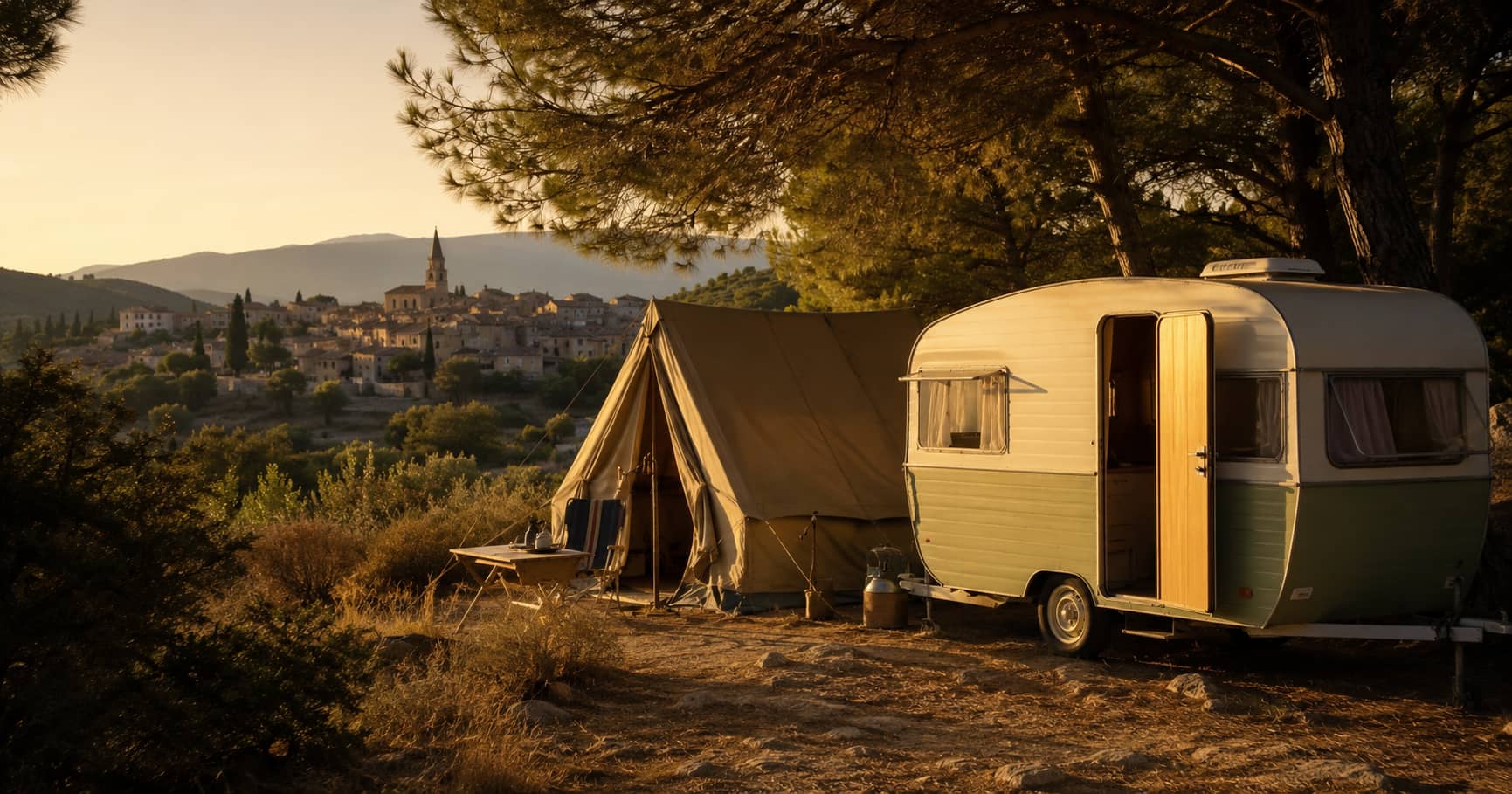
Camping in Provence now ranges from simple tent pitches to serviced motorhome stops and fully equipped mobile homes. That variety can make outdoor tourism feel modern, but its roots are tied to a much older change in European travel: ordinary families gaining the time, transport and equipment needed to take holidays independently. Provence became one of the natural beneficiaries because it combined a warm climate, long coastlines, rural landscapes and road access to historic towns.
This editorial history explains how camping moved from a specialist outdoor pursuit to a major form of tourism in southern France. It does not claim that every campsite followed the same path. Coastal resorts, inland farms and urban-edge sites developed differently. The useful point for today’s camper is to understand why Provence offers such a mixed network of pitches, holiday parks, campervan areas and nature-based stays.
From an elite pastime to paid holidays
The word and practice of recreational camping emerged in Europe around the end of the nineteenth century. Early camping was associated with well-equipped travellers, cycling clubs and people who had enough leisure time to sleep outdoors for pleasure. The French Federation of Campers, Caravanners and Motorhome Users notes that the term entered use around 1898 and that camping expanded much more widely in France after paid holidays were introduced in 1936. That social reform gave workers both time off and a reason to seek affordable accommodation.
Provence was well suited to this new form of travel. Railways already connected major towns, while the growth of private motoring gradually opened smaller coastal and inland destinations. A tent allowed visitors to stay near beaches, pine woods, rivers and villages without depending on a hotel. The appeal was practical rather than luxurious: carry basic equipment, choose a simple site and spend most of the day outdoors.
The post-war road holiday changes Provence
In the post-war period, car ownership, improved roads and mass-produced camping equipment changed the scale of domestic tourism. Families could travel with larger tents, folding furniture and food supplies. Caravans then offered more shelter and storage, making longer stays easier. In Provence, this encouraged the development of organised grounds near the Mediterranean, around lakes and outside towns where land was available and visitors could reach attractions by road.
This period also created the basic pattern that still shapes many camping holidays: one main base with day trips in several directions. A site near Aix-en-Provence could support visits to the city, Sainte-Victoire, Marseille and the Luberon. The model reduced packing and driving while giving visitors access to very different landscapes. Today’s hub-based itineraries are therefore not a new invention; they are a refined version of the post-war touring holiday.
Regulation and the rise of the organised campsite
As camping became more popular, informal fields and roadside stops were no longer enough. Sanitation, fire safety, access, waste collection and the separation of vehicles from living areas required clearer standards. The FFCC records that it was involved in the first official French camping rules from the 1950s. Over time, formal classification and planning rules helped distinguish authorised campsites from casual overnight use and gave travellers more predictable facilities.
That history matters in Provence because environmental pressure is high. Dry summers, forest-fire risk, crowded coastlines and protected landscapes limit where people can safely stop. Modern restrictions on open fires, access to forest massifs and overnight parking are not simply anti-camping measures. They reflect the consequences of large visitor numbers in a region where a small mistake can block emergency access or start a serious fire.
From canvas to caravans, motorhomes and mobile homes
By the 1970s, camping had become a familiar family holiday in France. The equipment market expanded, campsites added pools and organised activities, and caravans became common on long summer stays. Later, motorhomes offered greater mobility, while mobile homes allowed guests to use campsite facilities without owning outdoor equipment. These formats now sit beside smaller tent areas, farm stays and basic campervan service points.
The result is a sector that serves several different needs under one name. A touring cyclist may want a quiet pitch and a shower. A family may prioritise shade, a pool and a refrigerator. A motorhome traveller may need fresh water, legal waste disposal and a bus connection into town. Good planning begins by identifying the travel style rather than assuming every place labelled camping provides the same experience.
Why Aix-en-Provence became a useful inland base
The coast has always attracted summer campers, but inland bases gained value as roads improved and tourism spread beyond beach holidays. Aix-en-Provence offers food shops, transport links, medical services and cultural attractions, yet it remains close to open countryside. It also sits between several major trip areas. That geography makes it practical for visitors who want Provence without moving their camp every night.
The modern approach is to use that base carefully: leave large vehicles outside historic centres, check seasonal access before entering protected landscapes and match each outing to temperature and wind. The site’s first-time camping guide to Provence covers the basic planning decisions that grew out of this long history.
Camping history still shapes the trip you take today
Provence camping evolved through social reform, mass motoring, regulation and changing equipment. Each stage left something behind: affordable outdoor holidays, touring routes, organised facilities and a wider choice of accommodation. It also produced today’s limits, especially around fire prevention, waste and vehicle access.
Understanding that background leads to a more realistic holiday. A campsite is not merely a cheaper hotel, and a campervan is not a licence to stop anywhere. Both belong to a travel tradition built on independence balanced by shared rules. For further historical context, see the FFCC overview of camping history and its account of how French camping regulation developed.