Provence Toll Roads by Campervan: Classes, Costs and Safer Planning
French motorways can make a Provence trip faster, but campervan tolls are not calculated exactly like car tolls. Height, authorised weight and axle configuration affect the vehicle class. A route that looks inexpensive for a car may cost more for a tall motorhome, and a wrong lane can create stress at the barrier.
This guide explains the decisions to make before using the autoroute. It does not list fixed prices because tariffs change and depend on entry and exit points. Instead, it shows how to identify your class, estimate costs with the correct vehicle profile and decide when a slower non-toll road is actually the better option.
Measure height and check authorised weight
VINCI Autoroutes describes a typical motorhome between 2 and 3 metres high with an authorised gross vehicle weight up to 3.5 tonnes as Class 2. A vehicle at least 3 metres high or above 3.5 tonnes generally moves into Class 3, subject to the operator’s full classification rules. Roof loads and permanent equipment matter, so use the real travelling height.
Carry the registration document and note the vehicle’s weight category. If the automated system assigns a class that appears wrong, use the assistance button before paying rather than reversing. Never leave the vehicle in a live toll lane. The operator can review the classification and explain the charge.
Choose lanes without low height barriers
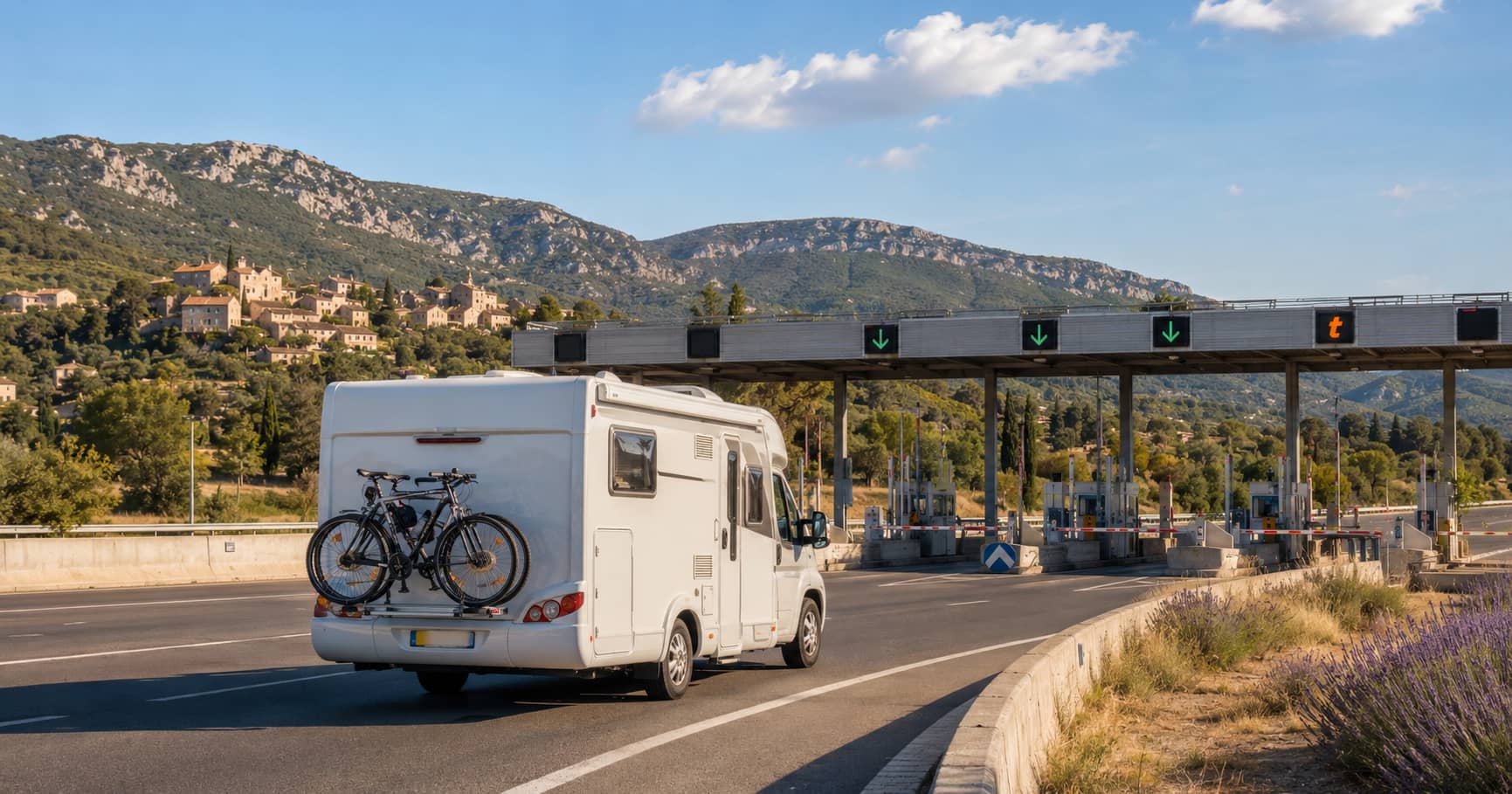
Some toll lanes have a 2-metre height gantry and are intended for Class 1 vehicles. A campervan with roof equipment must use a lane without that restriction. Approach slowly, read the symbols early and leave enough space to change lanes safely. Do not follow a car into a lane simply because it appears shorter.
Bicycle racks and trailers also change how you position the vehicle. Stop close enough to reach the machine without scraping the side, fold mirrors only if necessary and make sure the rear clears the island before turning. If travelling with a passenger, agree that only the driver handles decisions at the booth so instructions remain clear.
Estimate the whole route, not one motorway section
Use an official route calculator with the correct class and compare at least two options. A toll route may save time around Marseille or on a long transfer, while a local road may be better for a short day trip. Include fuel, additional distance and driving fatigue. Saving a small toll is not useful if the alternative adds an hour of stop-start traffic through towns.
Also account for campsite arrival hours. Paying for a faster section can be sensible if it avoids reaching a gated site after reception closes. Conversely, a scenic non-toll road is worthwhile when it forms part of the day and the vehicle is suitable for its width and gradients. Cost is only one part of route quality.
Avoid urban shortcuts with a large vehicle
Navigation apps sometimes leave the motorway early to save a few euros or minutes. Around Aix and Marseille, that can send a campervan into dense traffic, narrow junctions or low-emission areas. Review the last part of the route on a larger map and add a waypoint that keeps you on an appropriate access road.
Marseille has a low-emission zone that applies to visitors as well as residents, and rules can be adjusted during pollution episodes. Check the current Crit’Air requirements before entering. A toll calculation does not confirm that the final urban route is legal for your vehicle.
Prepare for payment and breakdowns
Keep a physical bank card available even if you normally use a phone. Confirm international payment settings and store the card where the driver can reach it safely. A compatible toll badge can simplify repeated travel, but it does not remove the need to select a lane suitable for the vehicle’s height.
On a motorway, breakdown recovery follows regulated procedures and only authorised operators can intervene on concession roads. Move as far from traffic as possible, use an emergency point or the operator’s approved contact method and follow instructions. Carry reflective equipment where it can be reached without unloading the rear storage area.
Use toll roads selectively
For a hub stay near Aix, toll roads are most useful for transfers and specific time-sensitive outings. Many local days can be planned without them. The new Aix campervan parking guide also explains why reaching the city edge cleanly is more important than following the shortest route to the centre.
Before departure, verify your class on the official VINCI motorhome toll guide and calculate the actual itinerary. A calm toll-road trip starts with exact dimensions, the correct lane and a route selected for the vehicle rather than for a standard car.
Keep a written vehicle profile
Store the travelling height, authorised weight, registration country and emergency contacts in the cab. Add a photograph of the registration document in secure offline storage. This makes it easier to explain a classification issue and prevents a passenger from giving an approximate answer at a toll booth.