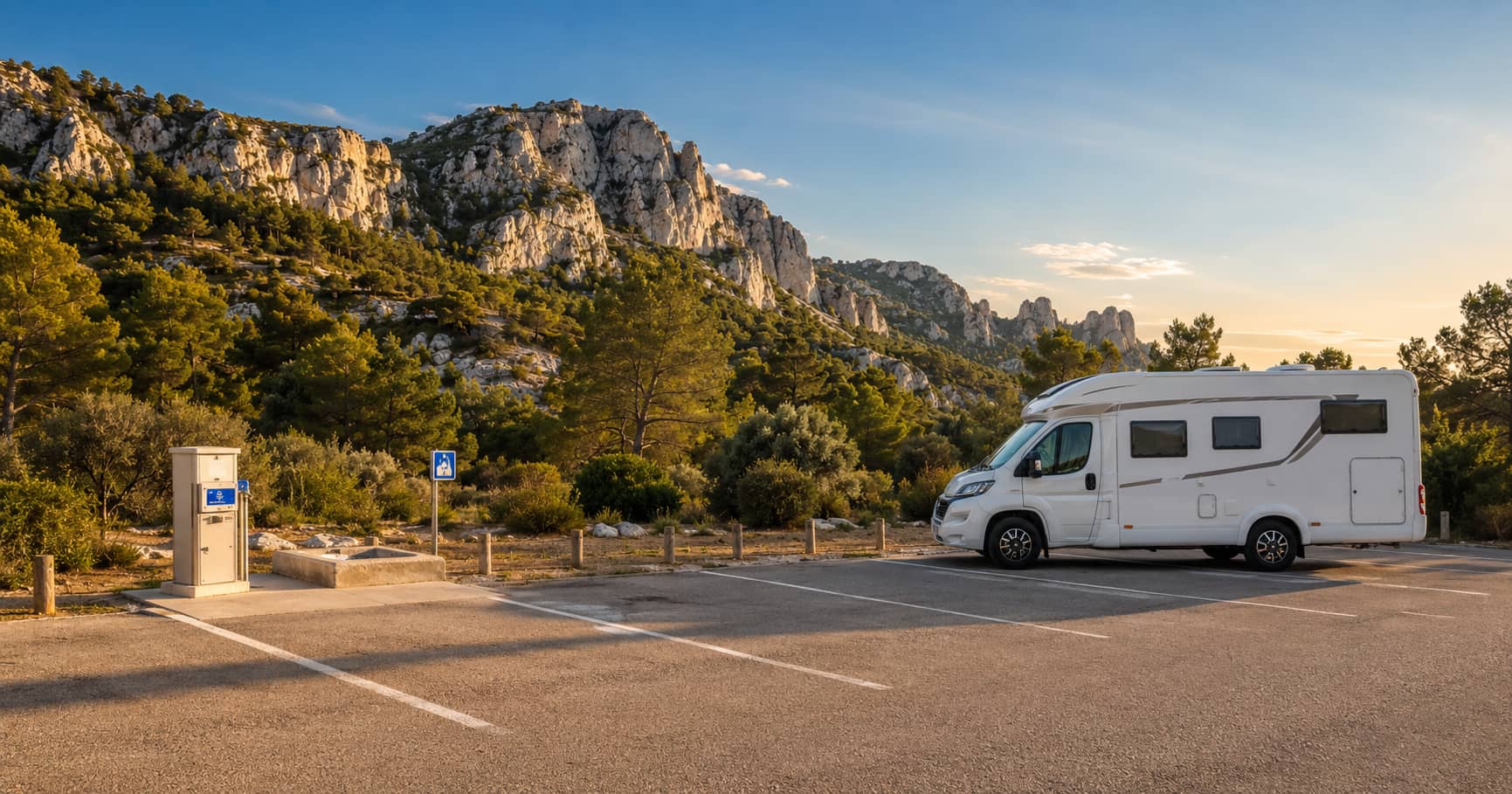
Wild Camping Rules in Provence: Parking, Overnight Stops and Legal Alternatives
The phrase wild camping hides several different activities: pitching a tent outside an authorised site, sleeping inside a parked campervan, occupying public land and stopping on private property. French rules do not treat all of these in the same way, and local restrictions can be stricter in protected or high-risk areas.
The safest approach in Provence is to use authorised campsites, campervan aires or written permission on private land. Do not rely on social-media coordinates or the fact that another vehicle stayed somewhere. A location can be tolerated one night, prohibited the next or unsafe during fire and flood conditions.
Parking is not automatically camping
A legally parked vehicle that remains within its marked space is different from setting up an outdoor camp. Opening an awning, placing chairs, using levelling blocks, cooking outside or discharging water can turn a parking stop into occupation of the surrounding area. Local signs and municipal rules determine what is permitted.
Sleeping inside the vehicle does not cancel parking restrictions. Time limits, vehicle category bans, height barriers and overnight prohibitions still apply. If the sign is unclear, use an authorised alternative rather than testing enforcement after dark.
Protected landscapes have additional limits
National parks, regional natural parks, coastal sites, forests and classified landscapes may restrict camping and vehicle access. In the Calanques, summer fire-risk closures and road restrictions require daily checks. In the Luberon, the park’s visitor guidance tells people to use designated parking and avoid wild camping for safety.
These areas also need clear routes for emergency and agricultural vehicles. Never stop in front of a barrier, water tank, track entrance or turning area. A flat piece of ground beside a forest road may be operational space rather than a campsite.
Fire risk changes the seriousness of a stop
Provence has dry vegetation, strong winds and periods of extreme fire danger. The Bouches-du-Rhône prefecture can restrict access to forest massifs, especially in summer. A stove, cigarette or hot vehicle component near grass can create a major risk.
Do not light fires or use cooking equipment where it is prohibited. Follow the rules of the authorised site and choose a cold meal when conditions are poor. A secluded place does not make fire use safer; it can delay detection and emergency response.
Private land requires real permission
An unfenced field is still private property. Ask the owner or authorised manager before entering or staying. Permission should cover the exact activity, number of nights and vehicle. Respect crops, livestock, gates and water supplies, and leave without trace.
Do not assume that buying something from a farm grants an overnight stay. Some farms operate formal camper stops, while others cannot accept visitors because of insurance, planning or access limits. Use established networks or direct written confirmation.
Why authorised stops are usually better
A campsite or aire provides a legal address, waste arrangements and clearer expectations. It reduces the need to search for a place while tired and prevents the common mistake of entering a narrow road at sunset. The comparison of campsites and campervan aires helps match the stop to the trip.
Authorised sites also protect water and soil. Black water must go into a dedicated disposal point, and grey water should never be released onto the ground or into a street drain. Carry enough capacity to reach a proper service facility.
A legal overnight decision checklist
Confirm who manages the land, read all entrance signs, check fire and weather alerts, verify the vehicle fits and identify the permitted behaviour. Arrive before dark and keep a second authorised option. If any part is uncertain, move on before unpacking.
Wild camping may appear flexible, but in busy Provence it often transfers work and risk to the traveller. Legal campsites, aires and approved private stops provide the independence most people actually want: a quiet night without worrying about access, enforcement, waste or an emergency evacuation.
Do not confuse an app listing with permission
Crowdsourced camping apps can help identify possible stops, but a pin is not legal authorisation. Entries may be old, placed on private land or created before a barrier and local rule changed. Use the app as a lead, then verify the site through the municipality, operator or current signs.
Recent comments can reveal noise or access problems, yet they do not override official restrictions. A traveller reporting that nobody objected is describing one night, not establishing a right to stay.
Keep the next authorised campsite or aire saved before approaching any uncertain stop. This prevents fatigue from becoming the reason you remain somewhere unsuitable. The backup should be reachable before its gate or reception closes.
Leave immediately when an authorised person asks
Do not argue that an app, old review or lack of a barrier gave permission. Pack without spreading equipment farther and move to the saved legal alternative. Calm compliance protects access for other travellers and avoids turning a misunderstanding into enforcement action.